
The camera grew a soul
One day since the last entry, and it turned into a whole feature arc I didn’t plan. A game I’ve been playing lately, one I’ll talk about properly another time, made me realize my camera was a utility when it should be a pursuit. So this update is mostly one big love letter to photographing your fish properly.
The camera is a lens now
The old camera was a fixed frame you dragged the tank around under. Now:
- Your cursor IS the lens. The viewfinder follows your mouse across the whole tank: crosshair reticle, corner brackets, the works. You chase the fish, not the camera.
- Left click is the shutter. No capture button. Scroll still zooms.
- The frame tells you when you’ve got the shot. When a fish is well-centred in the lens, the whole frame warms to gold, a ring highlights your subject, and a caption names the moment: “Guppy, Zoomies!” That’s your cue. Click NOW.
- A little bar along the bottom shows mouse pictograms with the right button lit: zoom, shoot, pan. No walls of instruction text.
Got a new photo!
Shots don’t auto-save anymore. Click the shutter and the photo pops up big in a polaroid card, Save or Ditch. Nothing counts until you keep it: no gallery entry, no rewards, no collection credit. Keeping the photo is what makes it real, which also means you can’t shutter-spam your way through the collection. One honest detail I’m proud of: the card credits what was happening at the click, not whatever the fish wandered off to do while you were deciding.
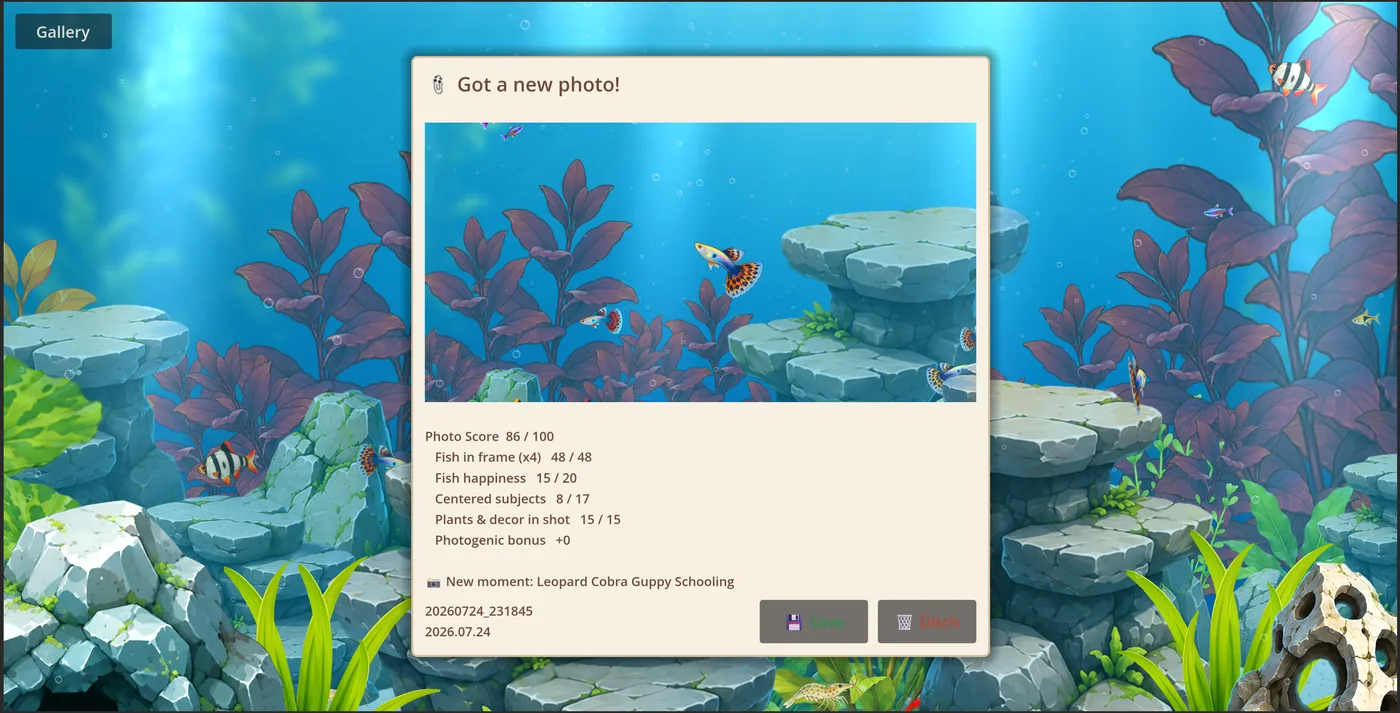
And the score finally explains itself. Instead of a mysterious “50/100,” the card breaks it down:
- Fish in frame: up to 48 (three fish maxes it)
- Fish happiness: up to 20 (happy fish photograph better)
- Centered subjects: up to 17
- Plants & decor in shot: up to 15 (partial credit if leaves poke into frame)
- Photogenic fish: a pure bonus on top, not a requirement
Those four base criteria sum to exactly 100. A perfect shot is a group of happy fish, centred, in a dressed scape, and now the card teaches you that instead of making you guess.
Moments: the collection layer
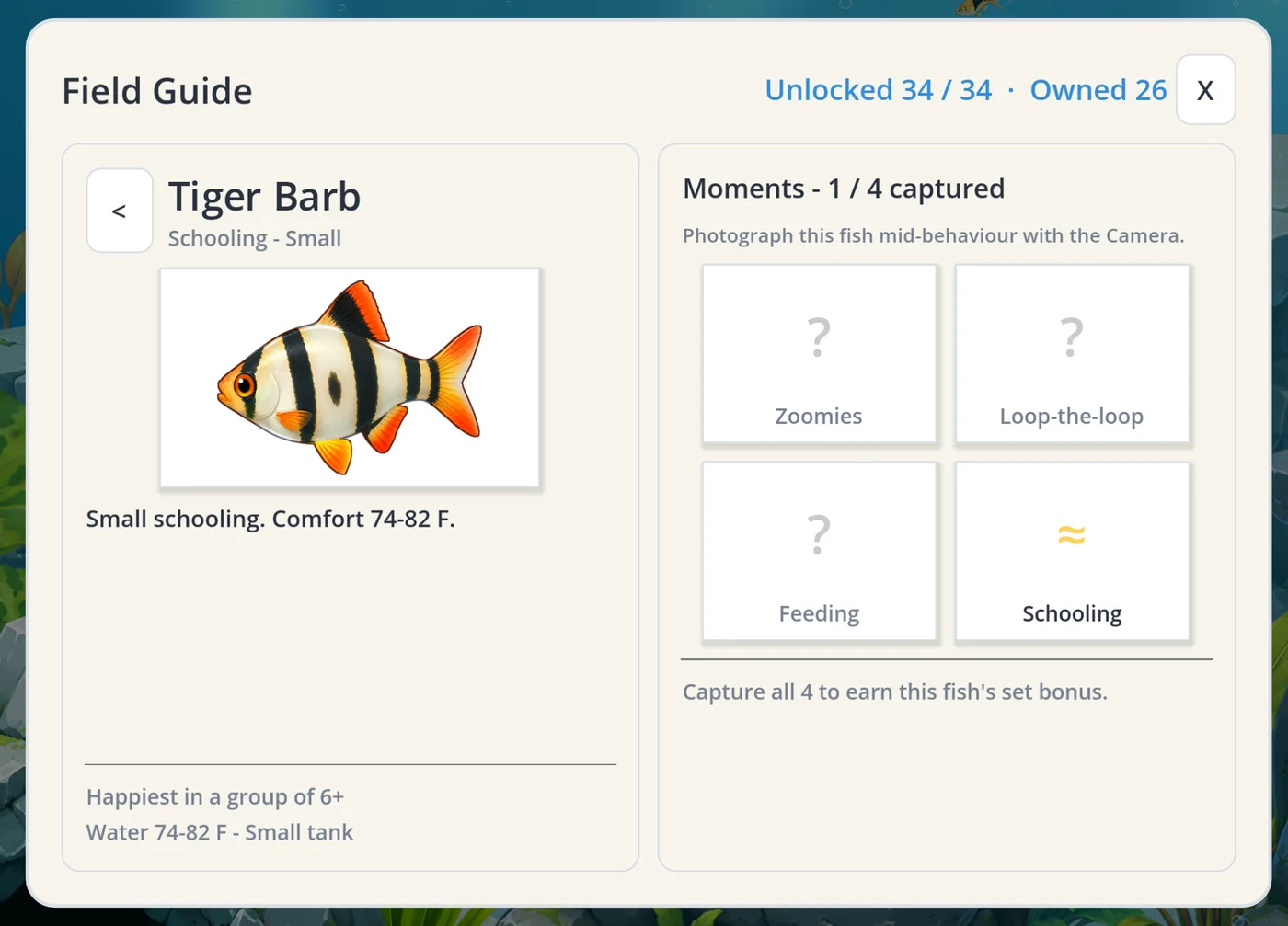
Every fish species now has four moments to capture on camera: Zoomies, Loop-the-loop, Feeding, and Schooling. Photograph a fish mid-behaviour and the moment is logged to its Field Guide entry. Fill all four for a species and its card gets starred (plus a little bonus: the real completion prize is still brewing).
This quietly changes what the camera is for. Before: take a nice picture. Now: your Cardinal Tetras have an empty “Loop-the-loop” slot, and Loop Drops exist, and suddenly you’re staging a photo shoot with fish candy. That’s the game I wanted.
The Field Guide became a notebook
Click any discovered fish and the guide opens a proper two-page spread: portrait in a taped-in polaroid, when you first met the species, its story, and its care notes on the left, and the moment collection on the right as a grid of little photo cards, gold when captured, a grey ”?” when not. Every discovery is date-stamped from now on, so the guide slowly becomes a diary of your tank’s history.
Small delights
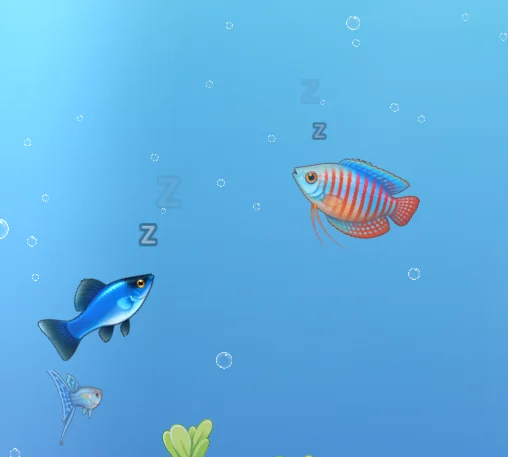
- Sleeping fish now show zZz’s, little glyphs drifting up from resting fish. The tank at night got 40% cozier with fifteen lines of code.
- The main menu buttons stopped pretending to be a billboard (they were stretching to the logo’s width: a one-line container fix I get to be embarrassed about).
- “Skins” in the Store is now Backgrounds, because that’s what they are: the whole scene behind your tank. Greek marble and a Medieval keep are in, the default is always a click away, and each tank remembers its own.
Where things stand
Still waiting on Steamworks (correct selfie submitted this time). Capsule art is iterating. The store copy grew honest sections about fish personalities and the recolour system, and the trailer shot list now includes chasing a zoomie with the gold lens: because if it makes me grin during testing, it goes in the trailer.
Tell me which moment your fish refuses to perform on camera. Mine’s the Corydoras, who has apparently never once felt joy while I was holding the lens.
— K.