
The sponsors got faces
A big stretch this time, on three fronts at once: the sponsorship system grew a personality, the whole aquascaping menu got torn down and rebuilt, and the tank learned to do mood lighting. Let me start with the one that changed the feel of the game most.
Sponsors are characters now, and they call you
For a while, sponsors were just contracts: a list of offers you’d pick from. This update turned them into a cast of actual people, each with a face and their own taste.




There’s Amara, who curates relics for Nile Antiquities and wants a channel to show off her Egyptian collection. Nerissa deals in Deepwater Relics and is all-in on the Atlantis look. Captain Sol runs Saltspray Salvage and brings the pirate gear. And Reed, from Aquascape Weekly, is the steady one who teaches you the fundamentals. Each one promotes their own decor collection, so the people and the things you’re collecting are now the same story. Getting the portraits back was the point where the roster stopped being a spreadsheet to me, Sol in particular grew on me fast.
The part I’m happiest with: they literally phone you. When the opening tutorial wraps up, your in-game phone starts ringing and tilting: tap it, and a sponsor opens a chat with their pitch and an Accept button. Thalia calls first, then Reed once you’ve finished her first request. It means the tutorial for the entire sponsorship loop is just… answering the phone. No wall of instructions. You learn the loop by living it.
I also added an onboarding gate so new players don’t get firehosed: Reed and Thalia come first, and the rest of the roster stays locked (dimmed, with a hint) until you clear that first pair. Once you’re rolling, you can run as many missions at once as you like: there’s a stacked tracker in the corner now, and you choose which ones it follows.
A whole new set: the Egyptian collection
Amara’s quest line unlocks seven new pieces, and I think they’re some of the best art in the game so far.

There’s a Small Pyramid, a Canopic Chest, a Bastet cat statue, an Obelisk, a Sphinx, the Pharaoh statue above, and a Temple Gate your fish can actually swim through. While I was in there, I also re-homed the Atlantis and nautical sets behind Nerissa and Captain Sol, so every collection now belongs to someone.

The aquascaping menu got rebuilt from scratch
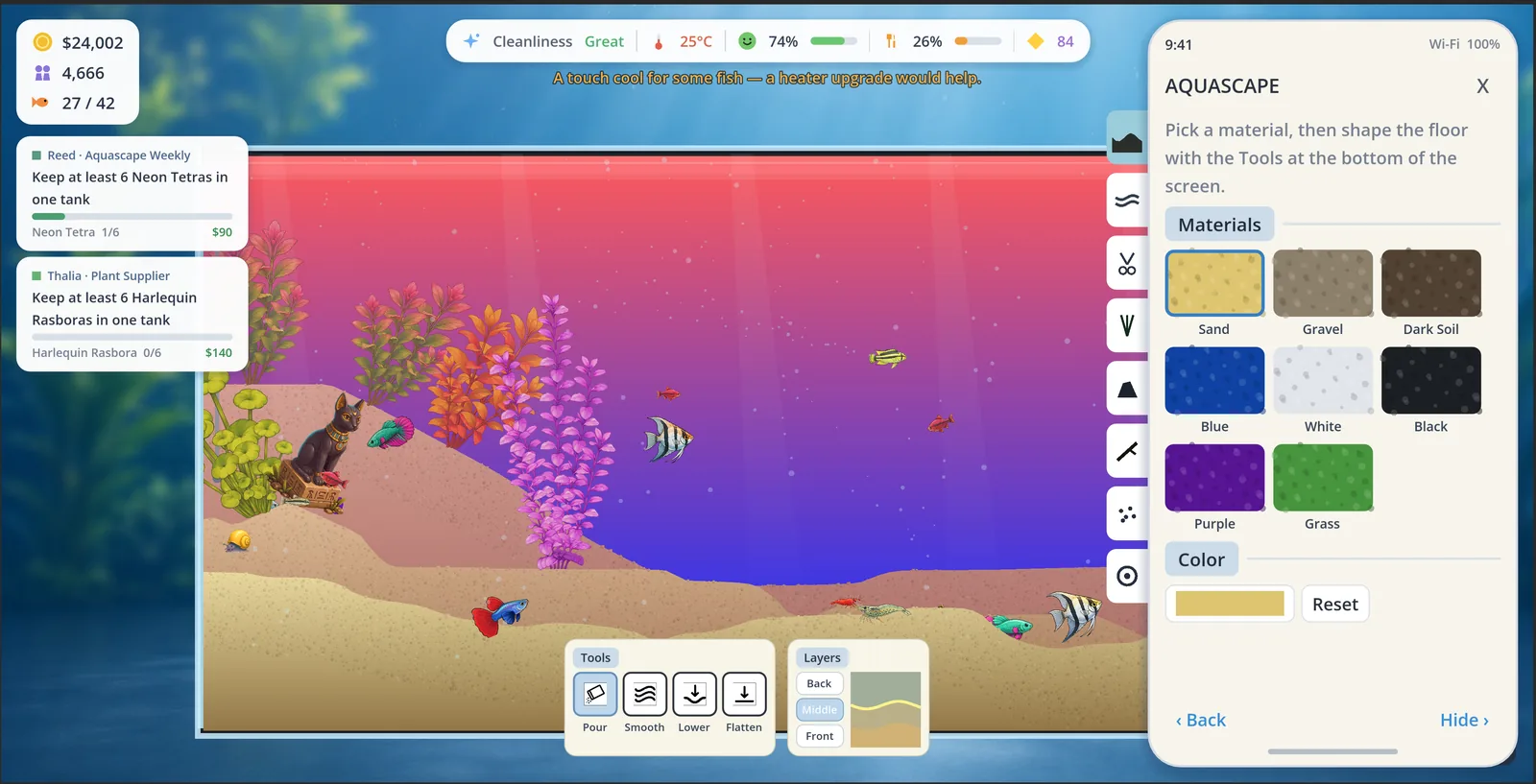
The substrate editor used to be a plain list of buttons. It now actually looks like a tool: picture swatches for each material, proper section headers, and a little cross-section diagram that finally makes Back / Middle / Front mean something visually, it even highlights the layer you’re working on. The Pour, Smooth, Lower, and Flatten tools got custom icons.
The bigger change is where the controls live. The Tools and Layers panels popped out of the phone into a floating two-card bar at the bottom of the screen, and the Relax/Feed/Light buttons politely slide out of the way while you’re sculpting. There’s also a Hide button that slides the whole phone off to the side so you get a clean, unobstructed view of the tank while you work, with a little tab to roll it back.
Making the world feel more alive
A few tuning passes that I think matter more than they sound:
Temperature finally does something. A cold tank with no heater now visibly stresses tropical fish, so the heater earns its place, while cold-water species would actually rather you turn it off. That last detail is the one I’m most pleased with, because it quietly gives you a reason to run more than one tank: a warm community in one, a cool-water crowd in another.
Hunger slowed way down: it’s now about eight minutes from full to hungry, so feeding is an occasional, gentle thing rather than a chore that nags you. And pouring substrate is a touch faster, because patience is not a gameplay mechanic.
The tank can turn to night
This is my favorite bit of the whole update. The receding substrate, plants, and decor now blend toward your actual water color instead of a fixed blue, so if you’ve set a wild purple water, it finally tints the entire back of the scene. And the darker your water, the more the scene sinks into shadow, strongest in the far distance. Set a deep, dark water and the whole tank reads almost like a night scene, with the foreground still catching the light. A feature paying off another feature is always the good kind of progress.
Underneath all that, two small fixes I’m glad to be rid of: fish now weave through the Atlantis temple columns instead of bonking into them, and bottom-crawling crew pass in front of floor decor instead of clipping behind it.
What’s next
The cast is assembled and the collections have homes. From here it’s about depth: more requests with more variety, so the people calling your phone always have something new to ask for.
Thanks for following along. 🐟